AI agent development
Assistants that qualify enquiries, prepare drafts, find information, or move a task forward. Built around your workflow, with clear tools, permissions, and human approval where it matters.
 LABS
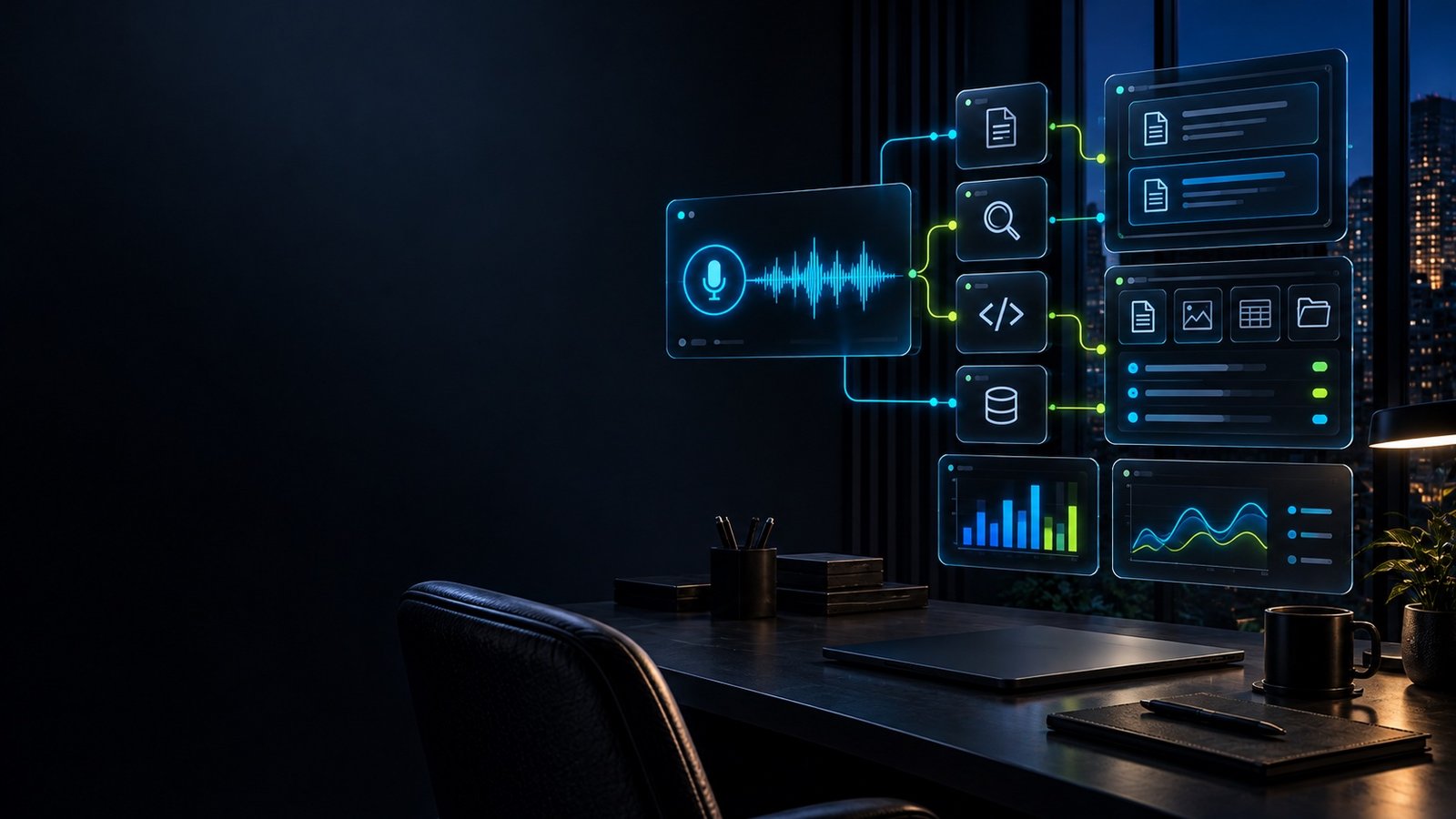
Practical AI development
I turn that workflow into a useful agent, app, or automation. Sometimes the answer is OpenAI. Sometimes it is Claude or Gemini. Sometimes it is not AI at all.
AI agents & connected offices
Your team knows the business. Your tools hold the information. I help connect them through useful agents, automations, and internal applications.
Assistants that qualify enquiries, prepare drafts, find information, or move a task forward. Built around your workflow, with clear tools, permissions, and human approval where it matters.
Add an action layer to the software you already use. An agent can interpret a request, gather context, coordinate tools, and propose the next step across a connected workflow.
Connect email, calendars, documents, spreadsheets, CRM records, and internal apps. Microsoft 365, Google Workspace, and other integrations are scoped around your existing access and available APIs.
Turn approved policies, manuals, project notes, and procedures into searchable context. Give teams answers with source references, role-based access, and a way to flag missing or outdated information.
AI platforms
Model choice is based on the job, data, privacy, quality, speed, tool support, deployment needs, and operating cost.
OpenAI
OpenAI API integrations for text, vision, voice, structured outputs, tool use, and agent workflows, with Codex available as part of the development and review process.
Anthropic
Claude API integrations for long-context work, document analysis, assistants, and tool-connected systems, plus Claude Code workflows for software development.
Google AI
Gemini API and Vertex AI paths for multimodal products, grounded experiences, function calling, search, data workflows, and Google Cloud deployments.
Microsoft
Azure OpenAI architectures, Microsoft Copilot Studio, GitHub Copilot workflows, identity-aware deployments, and Microsoft ecosystem connections.
Model options
Additional hosted and open-model options can be compared for grounded search, private infrastructure, speed, model routing, cost, and deployment control.
Architecture
Retrieval-augmented generation, Model Context Protocol servers, business tool connections, human approvals, observability, and evaluations make the model part of a dependable system.
What gets built
Useful AI needs an interface, approved context, tools, permissions, tests, monitoring, and a clear human handoff.
Goal-driven agents, customer or staff assistants, intake systems, research workflows, and task automation with controlled tool access.
Search and answer from approved documents, websites, product data, policies, records, or internal knowledge with traceable source context.
Workflows that can understand or generate combinations of text, images, audio, voice, video, forms, and structured business data.
Model Context Protocol connections and custom tool interfaces for CRMs, databases, calendars, email, ecommerce, support, and internal systems.
Customer-facing products, internal tools, dashboards, portals, mobile experiences, and existing applications with focused AI capabilities.
Permissions, privacy boundaries, prompt-injection controls, output checks, test cases, monitoring, cost controls, and human approval where it matters.
Independent guidance
Some products need a frontier hosted model. Others need fast structured extraction, grounded search, a private model, several routed models, or no generative AI at all. I compare the options before tying the product to one provider.
Production decisions include privacy, data retention, permissions, latency, context size, multimodal needs, reliability, evaluation results, provider portability, and the ongoing cost of each successful task.
AI development FAQ
Custom AI agents, assistants, workflow automations, retrieval systems, lead qualification tools, internal knowledge search, AI-enabled websites, and AI features for web or mobile apps.
Yes. A project can use OpenAI APIs for text, vision, voice, structured outputs, tool use, or agent workflows. OpenAI Codex can also support the development and review process when it fits the project.
Yes. Anthropic Claude can support production assistants, analysis, tool-connected workflows, and long-context use cases. Claude Code can be part of an AI-assisted software development workflow.
Yes. Model selection should consider output quality, privacy, latency, context, tool support, deployment options, and operating cost. The recommendation is based on the product requirement rather than loyalty to one provider.
Retrieval-augmented generation, or RAG, lets an AI system answer from approved documents or data. Model Context Protocol, or MCP, gives compatible AI clients a structured way to connect with tools and business systems.
Yes. AI can be introduced as a focused feature such as search, intake, summarization, document processing, customer support, content operations, or an internal assistant without rebuilding the entire product.
DARKKEVN Labs is an independent implementation studio. OpenAI, ChatGPT, Codex, Anthropic, Claude, Claude Code, Gemini, Google, Microsoft, GitHub Copilot, xAI, Grok, Meta, Llama, Mistral, and Perplexity are trademarks of their respective owners. Their mention describes compatible technology and does not imply endorsement or partnership.
Start
Share the workflow, users, data, privacy needs, current tools, and the result the AI system should produce.